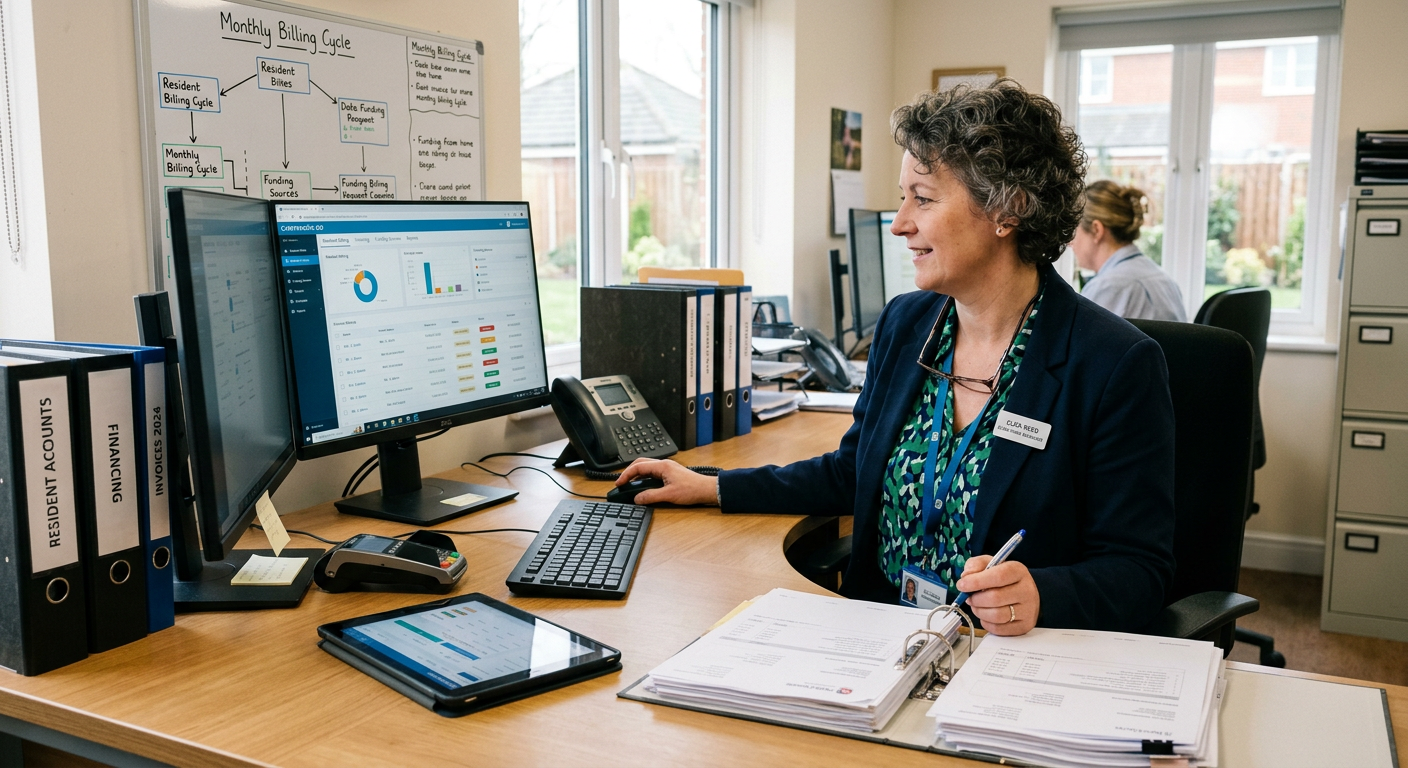


Ask any care home manager what they want from their technology stack and the answer is almost always the same: less of it. Fewer logins, fewer vendors, fewer spreadsheets bridging the gaps between systems that refuse to talk to each other. It is a reasonable ambition. And it is precisely the ambition that all-in-one care home management software platforms have spent the last decade promising to fulfil.
The pitch is seductive. A single platform handling resident billing, occupancy management, staff rostering, compliance reporting, financial forecasting and care planning, all from one dashboard, one contract, one support line. For a sector chronically short of time and administrative capacity, the appeal is obvious. But the reality, for many providers who have taken the plunge, is considerably more complicated.
The Promise and the Gap
The UK care home management software market has matured significantly. Platforms now offer genuinely broad functionality, moving well beyond basic billing and occupancy tracking to include real-time financial dashboards, automated local authority reporting, and integration hooks into care planning systems.
Yet a persistent tension runs through the sector: the all-in-one platform that does everything rarely does any single thing as well as the specialist tool built exclusively for that purpose. A platform with excellent resident billing may have a clunky rostering module. A system with strong compliance reporting may produce financial forecasts that a decent accountant would find embarrassingly basic. Providers who have consolidated onto a single platform often find themselves quietly maintaining workarounds – a spreadsheet here, a separate app there – that undermine the very integration they were sold.
This is not a failure of ambition. It is a structural problem. Building genuinely excellent software in multiple complex domains simultaneously is extraordinarily difficult. The vendors who try to do everything face an impossible prioritisation challenge: which module gets the next development sprint? Whose pain point gets fixed first?
The Best-of-Breed Counter-Argument
The alternative, assembling a best-of-breed stack from specialist providers, has its own well-documented costs. Integration is the perennial headache. When your eMAR system, your care planning platform, your rostering tool and your finance software all come from different vendors, the burden of making them communicate falls squarely on the provider. API connections that work perfectly in a demo have a habit of breaking quietly in production. Data that should flow automatically ends up being re-keyed by a senior carer who has better things to do at 7am.
There is also the commercial reality. Negotiating, managing and renewing multiple vendor contracts is a non-trivial overhead for a care home group, let alone a single-site independent operator. When something goes wrong (and something always goes wrong) the finger-pointing between vendors can leave providers stranded.
Where the Market Is Actually Heading
The more interesting question is not all-in-one versus best-of-breed, but whether that binary is becoming obsolete. The most sophisticated providers are increasingly building around a core platform, typically one anchored in either care management or finance, and using open APIs and integration middleware to connect specialist tools where the core platform falls short.
This approach demands more technical maturity than most care providers currently possess. But it reflects where the market is heading. Vendors who understand this are investing heavily in their integration ecosystems rather than trying to build every feature in-house. The platforms that will dominate the next decade are not necessarily those with the longest feature list, but those with the most open, reliable and well-documented integration architecture.
For providers evaluating care home management software today, the critical questions are rarely about features. They are about data ownership, API access, migration paths, and what happens when you want to swap out a module that is not working. A vendor who cannot answer those questions clearly is telling you something important about how they view the relationship.
The Consolidation Pressure
There is one more force shaping this market that deserves attention: the accelerating consolidation among care home groups. As larger operators absorb smaller ones, the pressure to standardise on a single platform across dozens or hundreds of sites intensifies. The economics of enterprise software licensing favour consolidation. So does the desire for group-level reporting and benchmarking.
But consolidation at scale amplifies the risks of a poor platform choice. A system that is merely adequate for a ten-bed home becomes a significant operational liability when it is running across fifty sites and processing millions of pounds of resident billing every month. The due diligence that should accompany these decisions is rarely as rigorous as it needs to be.
The all-in-one dream is not dead. But the providers who are getting the most from their technology investments are the ones who have stopped asking which platform does everything and started asking which platform do we build everything around. That is a subtler question, and a much more productive one.
Related Reading
- Digital Care Management Platforms in UK Care Homes: Where Are We in 2026?
- The Rota That Never Works: Why Care Homes Are Still Losing the Staffing Battle
- The CQC Inspection Is Coming. Is Your Evidence Ready, or Just Somewhere on a Shelf?
Frequently Asked Questions
What does all-in-one care home management software include?
All-in-one platforms typically combine care planning, medication management, staff rostering, resident records, activity logging, finance, and family communication in a single system. Examples include platforms from Nourish, Person Centred Software, Log my Care and Care Control, each with different strengths.
Is it better to use one integrated care platform or best-of-breed tools?
It depends on organisational size and complexity. Smaller single-site homes often benefit from the simplicity of one platform. Multi-site groups may find best-of-breed tools offer superior functionality in key areas, though integration complexity and data silos become challenges to manage.
How do care homes choose care management software?
Assess by: CQC reporting capability, ease of use for frontline staff, mobile app quality, integration with existing pharmacy or GP systems, implementation support, and pricing transparency. Always run a pilot with frontline staff before committing—adoption rate matters more than feature lists.