
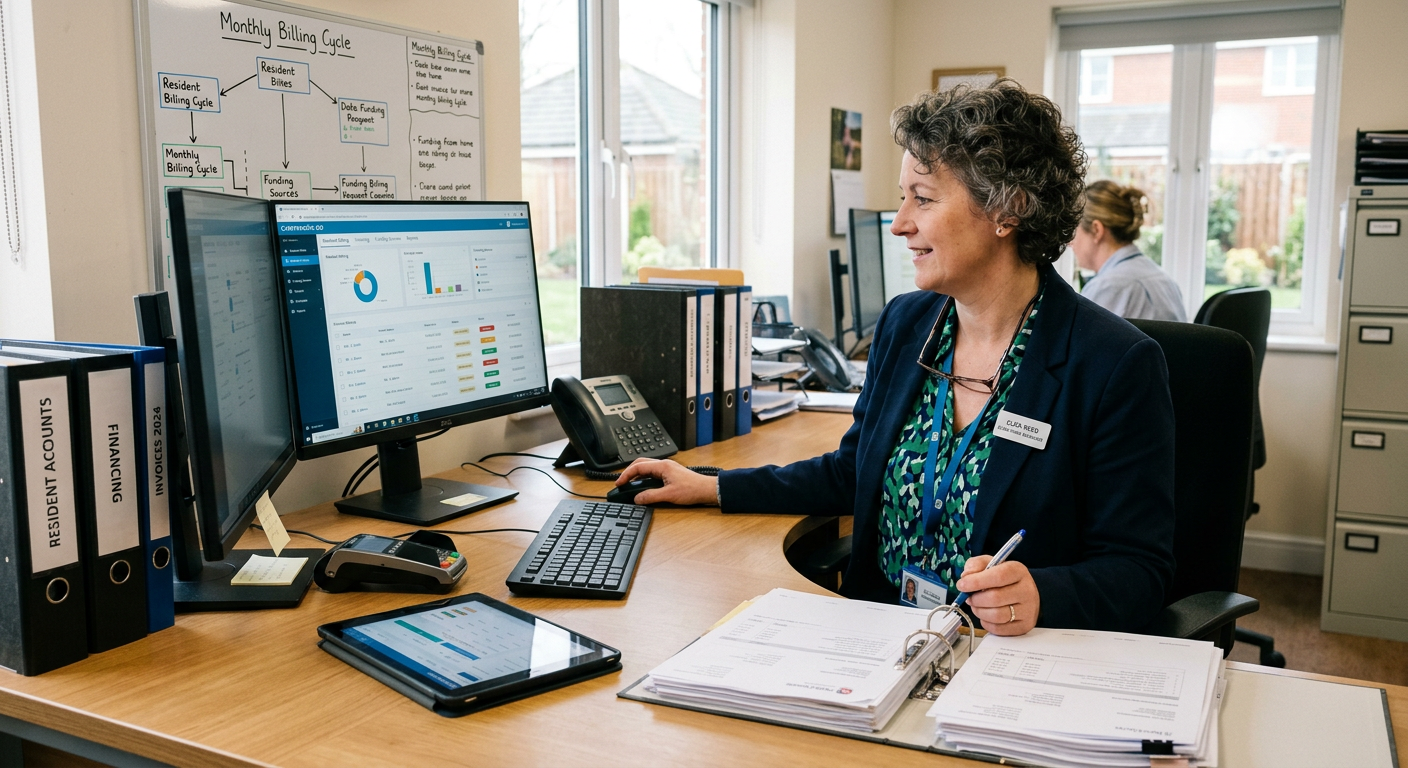
Ask a care home manager to describe their monthly billing process and you will hear one of two things: a weary sigh, or a very long story. Resident billing and invoicing in adult social care is, by any reasonable measure, a mess and the technology meant to fix it has, in many cases, made it more complicated.
A System Built on Exceptions
The fundamental problem is not a lack of software. It is that care home billing is structurally unlike almost any other service industry. A single resident may have their fees split between self-funding contributions, local authority payments, NHS Continuing Healthcare funding, top-up fees paid by family members, and deferred payment agreements with the council. Each funding stream has its own rules, its own review cycles, its own paperwork. And when a resident’s needs change, as they inevitably do, the billing arrangements shift accordingly, often mid-month.
Most billing software was not designed with this complexity in mind. It was designed for simpler transactional environments: a fixed fee, a monthly invoice, a payment. The result is that care providers frequently find themselves using specialist billing platforms that handle the basics competently but require extensive manual workarounds the moment anything unusual happens. Which, in care, is constantly.
The Local Authority Variable
If self-funded billing is complicated, local authority-funded billing is a different discipline entirely. Rates vary by council, by care package, by individual placement agreement. Some authorities pay in arrears; others in advance. Some require itemised invoices; others accept block billing. Reconciliation – matching what was invoiced against what was actually paid – can consume days of administrative time each month in a mid-sized care home.
The irony is that local authorities have, in many areas, invested significantly in their own finance systems. But those systems rarely talk to the care provider’s billing platform. The data flows one way, manually, via spreadsheets and email attachments. In 2026, this is not a niche problem. It is the daily reality for the majority of care providers in England.
What Good Looks Like, and Why It Remains Rare
The providers who have genuinely solved this problem share a common characteristic: they treated billing not as an administrative function but as a data problem. They invested in platforms that could hold the full complexity of a resident’s funding arrangement – every rate, every review date, every top-up agreement – and generate invoices automatically from that data rather than from manual input.
Some of the more sophisticated all-in-one care management platforms now include billing modules that do exactly this. The challenge is integration. A billing system is only as accurate as the data feeding it. If occupancy changes, fee reviews, and funding notifications are still being communicated by phone and email rather than through connected systems, the billing platform becomes a sophisticated tool for encoding manual errors more efficiently.
The providers making real progress are those who have connected their billing platform to their care management system, their occupancy tracker, and, where possible, their local authority’s placement portal. That level of integration remains the exception, not the rule.
The Human Cost of Getting It Wrong
There is a dimension to this that rarely appears in technology procurement conversations: the impact on residents and families. An incorrect invoice sent to a self-funding resident’s family is not just an administrative error. It is a source of distress, confusion, and, in some cases, a trigger for formal complaints. For families already navigating the emotional complexity of a loved one’s care, an unexplained charge or a billing dispute is the last thing they need.
Providers who have implemented clear, itemised digital invoicing, with accompanying explanations of what each charge represents, consistently report fewer billing queries and stronger family relationships. The technology, in this context, is not just an efficiency tool. It is a trust mechanism.
The Procurement Trap
Too many providers are still selecting billing software on the basis of price and surface-level feature lists. The questions that actually matter: Can it handle split funding? Does it integrate with our local authority’s systems? How does it manage mid-month fee changes? What happens when a resident is hospitalised for three weeks? are rarely asked during procurement, and rarely answered honestly by vendors.
The sector needs to get significantly better at specifying what it actually needs from billing technology, rather than accepting what vendors have built for a simpler world. That means finance directors and care managers sitting in the same room during procurement, not in separate conversations.
Until that happens, the monthly invoice that nobody can fully explain will remain a fixture of care home life, and the administrative burden it creates will continue to fall on the people least equipped to carry it.