
There is a moment, familiar to anyone who has sat through a mandatory training day, when the gap between what is being taught and what actually happens on a care floor becomes impossible to ignore. A PowerPoint slide about dementia-related distress. A role-play exercise with a colleague who keeps laughing. A video from 2014. And then, the next morning, a new member of staff faces a resident in acute distress for the first time, and none of it was quite enough preparation.
Extended reality – the umbrella term covering virtual reality (VR), augmented reality (AR), and mixed reality (MR) – is beginning to change that equation. Not by replacing human judgement, but by giving care workers something that classroom training has never been able to offer: the experience of being there before they are actually there.
What the Technology Actually Does
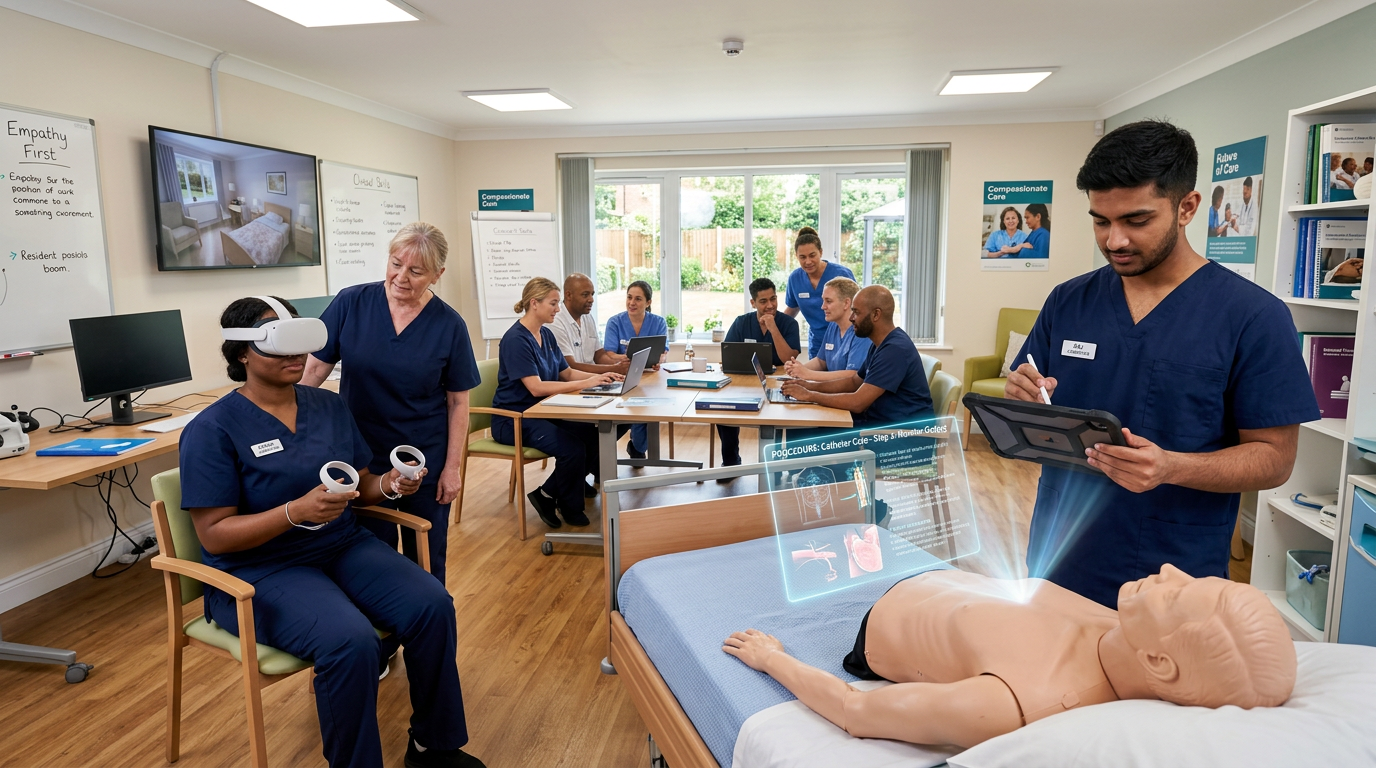
VR training in social care typically works by placing a staff member inside a fully rendered scenario; a resident’s bedroom, a communal lounge, a medication round, and asking them to respond to situations as they unfold. The scenarios are not passive. They branch. They respond to decisions. A resident becomes more agitated if the wrong approach is taken. A medication error has consequences. The learner is not watching a situation; they are inside it.
AR and MR applications tend to be more task-specific: overlaying guidance onto real environments, supporting manual handling technique, or walking a new employee through a care plan while they stand in an actual room. The technology is less immersive but more immediately practical — and considerably cheaper to deploy at scale.
Several UK providers are already piloting these tools. Skills for Care has flagged immersive learning as a priority area. A small but growing number of care groups, particularly larger operators with the budget to absorb early-adoption costs, are running VR induction programmes that compress what would previously have taken weeks of supervised shadowing into structured, repeatable simulations.
The Case for Immersion
The evidence base, while still maturing, is directionally consistent. Studies across healthcare settings suggest that immersive simulation training improves knowledge retention, builds confidence in high-pressure scenarios, and, critically, reduces the time it takes for new staff to reach competency. In a sector where turnover runs at over 30% annually and the cost of replacing a care worker is estimated at between £3,000 and £5,000, anything that accelerates safe, confident practice has an obvious financial argument behind it.
There is also a less quantifiable benefit. VR dementia empathy experiences, where a staff member temporarily inhabits the sensory world of someone living with dementia, experiencing distorted vision, fragmented sound, and spatial confusion, have been reported to shift attitudes in ways that no amount of classroom instruction achieves. Whether that shift is durable is a legitimate question. But the anecdotal evidence from providers who have used these tools is striking: staff who have been through the experience describe it as the most significant training they have ever received.
The Barriers Are Real
None of this is straightforward to implement. The upfront cost of a VR training programme – hardware, content licensing, technical support, and the staff time to run it – remains a significant barrier for the small and medium-sized providers that make up the majority of the UK care sector. A care home running on a 2% operating margin does not have a technology innovation budget.
Content quality is also uneven. The market has attracted a wave of vendors making bold claims on thin evidence. Procurement teams need to ask hard questions: What outcomes does this programme measure? What is the evidence that behaviour changes after the headset comes off? How does this integrate with our existing training records and compliance requirements?
There are also practical considerations that rarely feature in vendor demonstrations. Headsets need cleaning between uses. Some staff, particularly older workers or those with certain health conditions, experience disorientation or nausea. The technology requires a degree of digital confidence that cannot be assumed across a workforce where many staff are not native technology users.
Training as a Retention Strategy
Perhaps the most under-explored argument for immersive training is not about competency at all, it is about belonging. Care work is chronically undervalued, and one of the most consistent findings in workforce research is that staff who feel invested in are more likely to stay. A provider that offers VR training is sending a signal: we take your development seriously. We are willing to spend on your growth. That signal matters in a recruitment market where care providers compete not just on pay but on culture.
The technology is not yet mature enough to be a standard feature of every care home’s induction programme. But the trajectory is clear. Costs are falling. Content libraries are expanding. The regulatory environment, with CQC’s increasing focus on workforce competency as a quality indicator, is creating pressure to demonstrate that training is not just completed but effective.
The question for care leaders is not whether immersive training will become mainstream. It is whether they will be early enough to shape how it lands in their organisation — or late enough to inherit someone else’s implementation mistakes.