
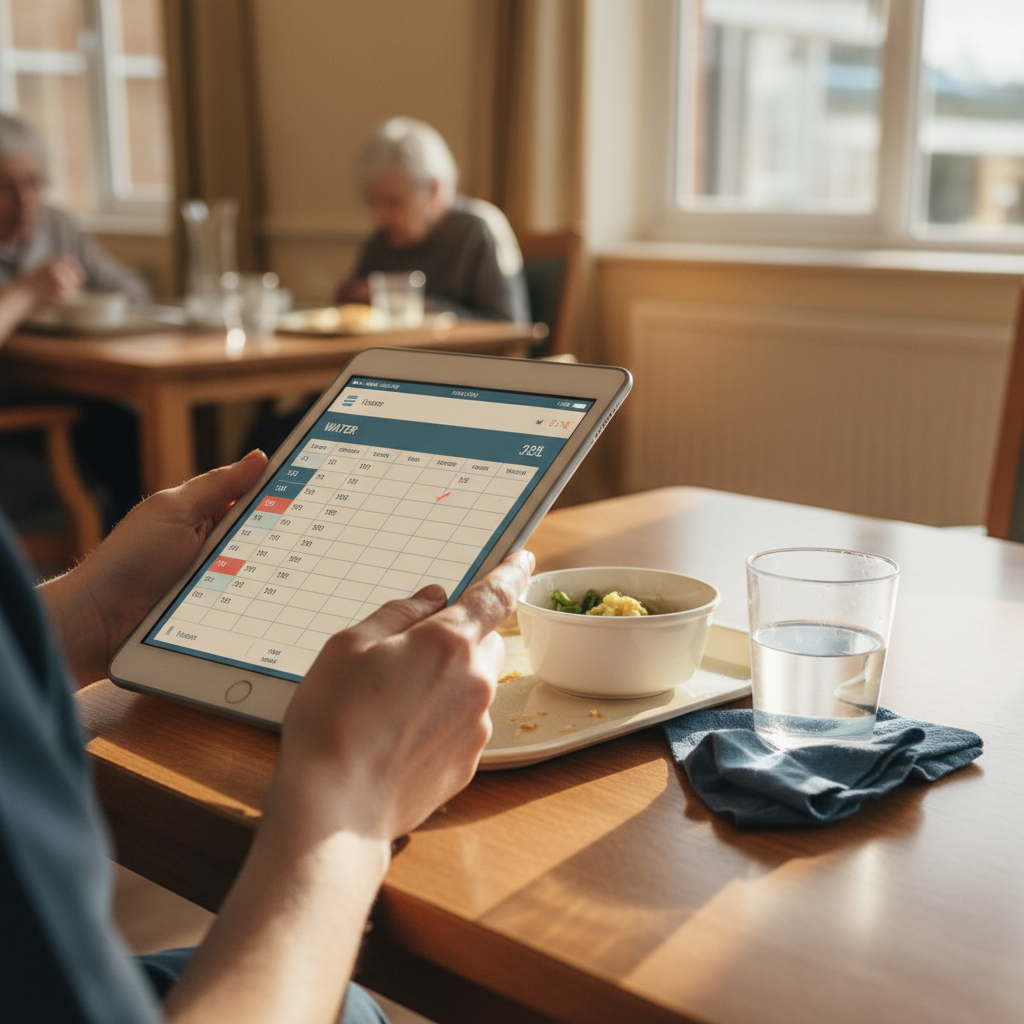
Every year, thousands of care home residents are admitted to hospital with dehydration or malnutrition, conditions that are, in the vast majority of cases, preventable. The clinical evidence is unambiguous. The regulatory expectation is clear. And yet, in 2026, the most common method for tracking what a resident eats and drinks in a UK care home remains a paper chart clipped to the end of a bed or tucked into a folder at the nurses’ station.
This is not a technology problem. It is a prioritisation problem, and the sector’s slow uptake of digital food and fluid intake monitoring tools is one of the more quietly damaging gaps in the care home technology landscape.
The Clinical Stakes Are Not Abstract
Dehydration in older adults is not merely uncomfortable. It accelerates cognitive decline, increases fall risk, contributes to urinary tract infections, and is a significant driver of avoidable hospital admissions. The NHS spends an estimated £13 million per year treating dehydration in older people, much of it originating in care settings. Malnutrition, meanwhile, affects an estimated 35% of care home residents on admission, and the evidence consistently shows that without systematic monitoring, it goes undetected for weeks.
Paper-based food and fluid charts are notoriously unreliable. Studies have found completion rates as low as 60% on general wards, and there is little reason to believe care homes perform significantly better. Entries are missed during busy mealtimes, estimated rather than measured, and rarely reviewed in real time by anyone with the clinical authority to act on them.
What Digital Monitoring Actually Offers
The tools now available to care providers go well beyond digitising a paper chart. The better platforms integrate nutrition monitoring and hydration monitoring directly into the care record, triggering alerts when a resident’s intake falls below a defined threshold over a rolling 24- or 48-hour period. Some systems use visual prompts – photographs of portion sizes – to help care workers record intake more accurately without requiring clinical training. Others integrate with weight monitoring and MUST (Malnutrition Universal Screening Tool) scoring, creating a continuous nutritional risk picture rather than a snapshot taken at admission and rarely revisited.
The operational benefits are real too. When a GP or community dietitian reviews a resident remotely, they can access a week’s worth of intake data in seconds rather than asking a care worker to locate and interpret a handwritten chart. When a resident’s condition deteriorates, the digital record provides an evidence trail that paper simply cannot.
So Why Isn’t Adoption Higher?
The honest answer is that nutrition and hydration monitoring has never enjoyed the same urgency, or the same commercial attention, as falls prevention or medicines management. Falls generate incident reports, regulatory scrutiny, and litigation. Medication errors are a CQC red flag. Malnutrition, by contrast, tends to creep. It rarely produces a single, attributable event. It is the slow background failure that nobody gets called to account for until it is very late indeed.
There is also a workflow problem. Mealtimes in care homes are among the most pressured points in the day. Staff are supporting residents to eat, managing dining room dynamics, and responding to competing demands. Asking them to simultaneously log intake on a device, however well-designed, requires genuine process redesign, not just a software rollout. Providers who have implemented these tools successfully are consistent on this point: the technology is the easy part. The hard part is building the habit, the expectation, and the accountability structure around it.
The CQC Dimension
Under the current CQC assessment framework, nutrition and hydration sits within the Safe and Effective quality statements. Inspectors are increasingly looking for evidence of systematic monitoring, not just that a MUST score was completed on admission, but that nutritional risk is being tracked, acted upon, and reviewed over time. A digital system that generates timestamped records, flags declining intake, and documents the care team’s response is a considerably stronger evidence base than a folder of paper charts with gaps.
Providers who have made this investment are finding it pays dividends not just clinically but regulatorily. The ability to demonstrate, in real time, that every resident’s food and fluid intake is being actively monitored is precisely the kind of systematic assurance that distinguishes a well-run service from one that is merely hoping nothing goes wrong.
The Uncomfortable Truth
The technology exists. The evidence base exists. The regulatory expectation exists. What has been missing, in too many services, is the organisational will to treat nutrition monitoring with the same seriousness as medication administration or falls prevention. That is a leadership question, not a technology question.
Digital food and fluid intake monitoring tools will not, on their own, solve malnutrition in care homes. But they will make it visible, and visibility is the precondition for everything else. A sector that prides itself on person-centred care cannot continue to treat one of the most fundamental aspects of a person’s daily wellbeing as an afterthought.
The paper chart had its time. That time has passed.
Related Reading
- The CQC Inspection Is Coming. Is Your Evidence Ready, or Just Somewhere on a Shelf?
- Digital Care Management Platforms in UK Care Homes: Where Are We in 2026?
- The Care Home That Knows Before You Do: Why Ambient Assisted Living Is No Longer Optional
Frequently Asked Questions
Why is food and fluid monitoring important in care homes?
Malnutrition affects an estimated 30–40% of older people entering care. Dehydration is a leading contributor to falls, UTIs and hospital admissions. Accurate monitoring of intake at meal times enables early intervention, supports personalised care planning and provides evidence of nutritional care for CQC inspections.
What digital tools are available for food and fluid monitoring in care homes?
Digital options range from simple tablet-based meal recording integrated into care management platforms, to specialist nutrition tracking apps that link to MUST screening tools. Some systems allow kitchen staff to log meals served while care staff record consumption—creating a complete intake picture.
Is food and fluid monitoring required by CQC?
CQC does not mandate a specific tool, but expects providers to demonstrate that nutritional needs are identified, monitored and acted upon. Failure to monitor food and fluid intake is cited in a significant proportion of inadequate ratings relating to the ‘Safe’ and ‘Effective’ domains.