
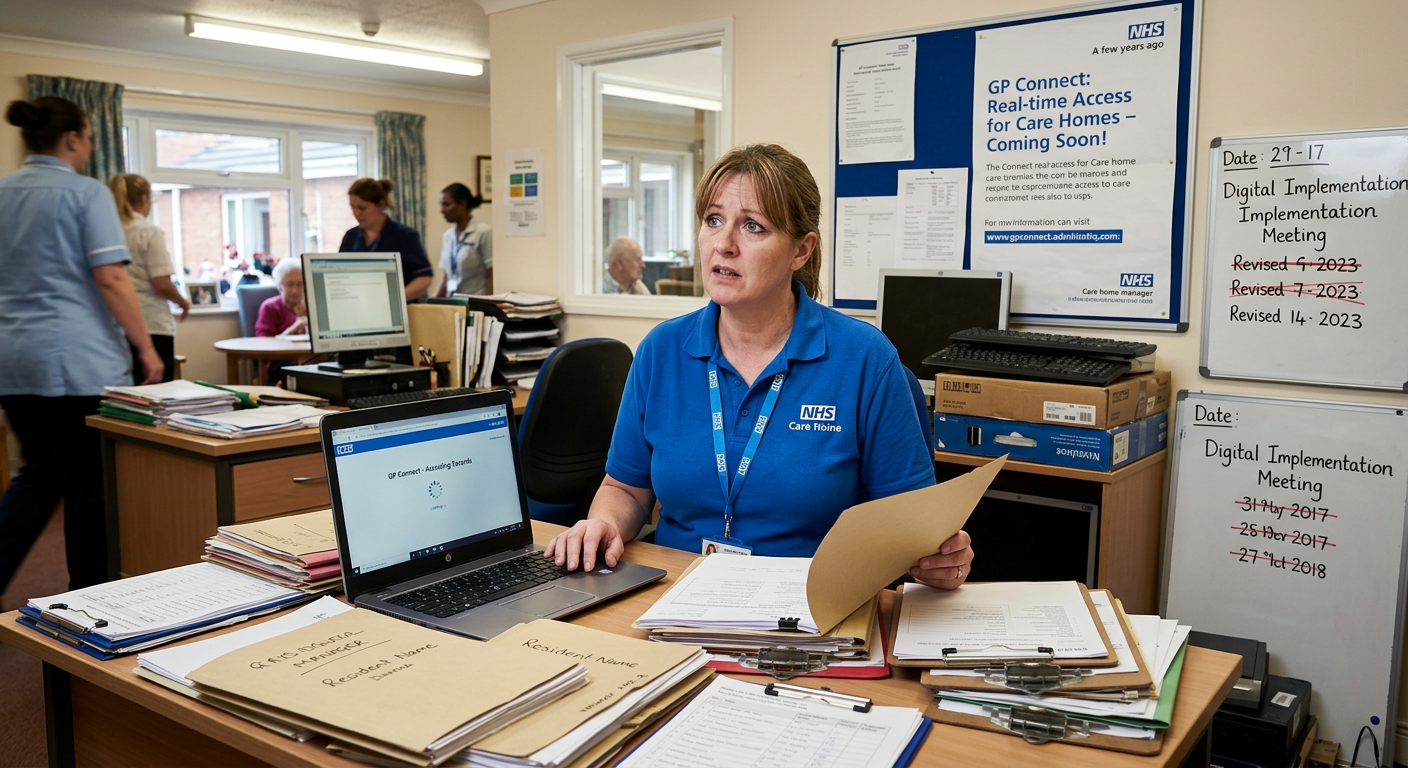
There is a moment familiar to almost every registered manager in England. A resident is rushed to A&E at 2am. The paramedics ask for a current medication list. The care home has one, on their own system. The hospital has another — on theirs. The GP has a third. None of them match. GP Connect was supposed to fix this. Years on, the question worth asking is: why hasn’t it?
What GP Connect Was Meant to Do
GP Connect is an NHS England programme designed to allow authorised care professionals to access GP-held patient records; appointments, medications, allergies, coded clinical data, directly from their own systems. For care homes, the promise was transformative: real-time visibility of GP records without the phone calls, the faxes, the delays. A genuine step toward NHS system integrations that would make care safer and more joined-up.
The technology works. Pilots have demonstrated that. The clinical case is unambiguous. When care home staff can see up-to-date GP records, they make better decisions. Medication errors fall. Hospital admissions drop. Handovers improve. The evidence base is not in dispute.
And yet, as of 2025, the majority of care homes in England still cannot access GP Connect in any meaningful, embedded way. The gap between what was promised and what has been delivered is not a technical failure. It is a systemic one.
The Integration Problem Nobody Wants to Own
The barriers to GP Connect adoption in care homes are well-documented and stubbornly persistent. First, there is the question of which digital care record system a provider uses, and whether that system has built GP Connect access into its platform. Many of the leading care management software providers have done so, or are in the process. But uptake across the sector is uneven, and smaller providers running legacy systems or paper-based records are effectively locked out.
Second, there is the local configuration problem. GP Connect access requires local NHS system integrations to be activated, which means ICBs, GP practices, and care providers all need to be aligned. In practice, this means navigating a patchwork of local agreements, information governance sign-offs, and technical configurations that vary enormously from one area to the next. A care home in one part of England may have seamless GP Connect access. Its counterpart twenty miles away may have none.
Third, and perhaps most corrosively, there is the question of who is responsible for making this happen. NHS England sets the framework. ICBs are meant to drive local implementation. Care providers are expected to adopt. But in the absence of a clear mandate, a funded implementation programme, or meaningful accountability, the default position is inertia.
The Information Governance Fog
Ask care home managers why they haven’t pursued GP Connect access and information governance anxiety features prominently. The DSPT (Data Security and Protection Toolkit) is a prerequisite, and while completion rates have improved, many smaller providers still find the process daunting. Beyond the DSPT, there are data sharing agreements to negotiate, legal bases to establish, and staff training requirements to meet.
None of this is insurmountable. But in a sector already stretched thin on management capacity, the cumulative weight of these requirements acts as a powerful disincentive. The providers who have successfully implemented GP Connect tend to be those with dedicated digital leads, strong ICB relationships, or the backing of a larger group. For the independent operator running two or three homes, the path is considerably harder.
This is not an argument against information governance. It is an argument for proportionate, well-supported implementation, and for the NHS to treat care homes as genuine partners in the integrated care agenda rather than afterthoughts.
What Good Looks Like
Where GP Connect has been properly implemented, the results speak clearly. Care homes report fewer unnecessary GP call-outs because staff can check current prescriptions and coded conditions before escalating. Medication reconciliation on admission and discharge becomes faster and more accurate. The 2am medication query has an answer that doesn’t require waking anyone up.
Some ICBs have invested in structured support programmes; dedicated digital facilitators, pre-negotiated data sharing agreements, and funded training, that have dramatically accelerated uptake. These are not complex interventions. They are largely a matter of will and resource allocation.
The Care Quality Commission’s Single Assessment Framework places increasing weight on safe, effective information sharing. Providers who can demonstrate real-time access to GP records are better positioned to evidence the kind of joined-up, person-centred care the framework demands. The regulatory incentive is there. The clinical case is there. The technology is there.
A Sector Still Waiting
GP Connect and the broader ambition of NHS system integrations for social care represent one of the clearest opportunities to improve resident safety at scale, without requiring new buildings, new staff, or new clinical pathways. The infrastructure exists. The standards exist. What is missing is the sustained, funded, accountable push to make it universal rather than patchy.
Until that happens, care homes will continue to operate in a data shadow, holding vital information about the people in their care, unable to see the full picture, and making decisions in conditions of unnecessary uncertainty. That is not a technology problem. It is a political choice dressed up as an implementation challenge.