
There is a moment that speech and language therapists describe with quiet frustration: a resident who has lost the ability to speak, who has the cognitive capacity to communicate, who has opinions and preferences and needs, and who is handed a laminated alphabet board because the care home doesn’t have anything better. In 2026, that moment is still happening. Regularly.
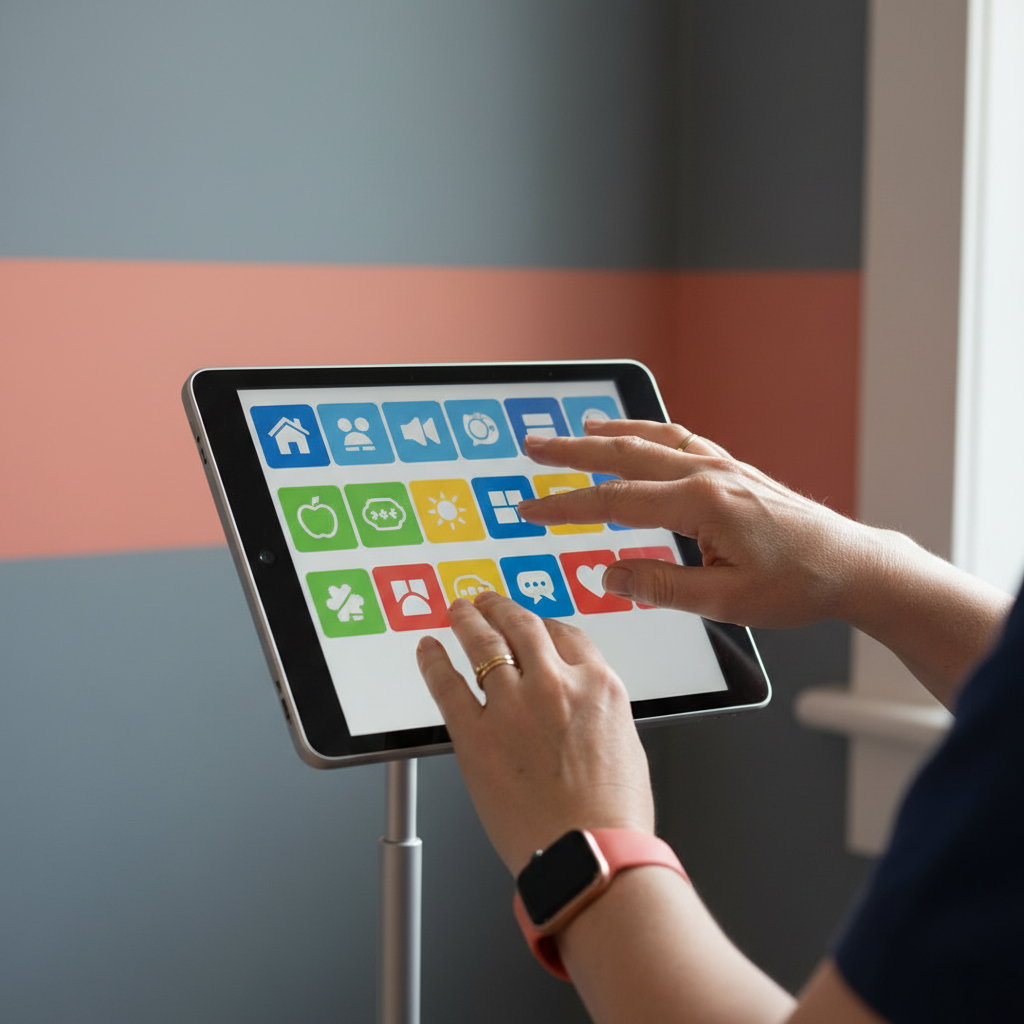
Eye-gaze technology, devices that track the movement of a user’s eyes to select words, symbols, or commands on a screen, has existed in clinical settings for over two decades. It is used in specialist neurological units, in schools for children with complex needs, in hospices. What it is not used in, with anything approaching consistency, is the mainstream adult social care sector. The question worth asking is why.
The Specialist Trap
The most persistent myth about eye-gaze technology is that it belongs in specialist settings, that it is a clinical tool for people with motor neurone disease or locked-in syndrome, requiring a speech and language therapist to configure and a technician to maintain. This framing has done enormous damage. It has kept the technology out of care homes where it could meaningfully change lives, and it has allowed providers to treat its absence as a reasonable default rather than a failure of ambition.
The reality is considerably more nuanced. Modern eye-gaze systems, from devices like Tobii Dynavox to more accessible tablet-based solutions, have become substantially easier to set up and use. Vocabulary sets can be pre-loaded. Calibration takes minutes. Staff training, where it is properly delivered, does not require clinical expertise. The specialist trap is, in large part, a perception problem that the sector has not been sufficiently challenged to confront.
Who Actually Benefits
The population of care home residents who could benefit from eye-gaze assistive technology is larger than most providers realise. It is not limited to people with progressive neurological conditions. Consider:
- Residents with advanced dementia who retain some capacity for intentional gaze but have lost verbal communication
- People who have had strokes and experience severe aphasia alongside physical impairment
- Residents with cerebral palsy or acquired brain injuries living in residential care
- Individuals in the later stages of Parkinson’s disease
For each of these groups, the ability to indicate a preference, to say yes or no, to choose a meal, to signal discomfort, to initiate contact with a family member, is not a luxury. It is a matter of dignity, autonomy, and in some cases, safeguarding. A person who cannot communicate pain is a person whose pain goes unmanaged. That is not a technology problem. It is a care quality problem.
The Cost Argument Doesn’t Hold
The second myth is cost. Eye-gaze devices do carry a price tag, dedicated hardware can run to several thousand pounds, but this framing obscures several important realities. First, tablet-based eye-gaze software has brought entry-level costs down significantly. Second, NHS England’s Augmentative and Alternative Communication (AAC) service can fund devices for eligible individuals, meaning the cost does not always fall on the provider. Third, and most pointedly: the cost of not providing communication support, in terms of unmet need, safeguarding risk, and CQC scrutiny — is rarely factored into the calculation.
Providers who have introduced eye-gaze technology consistently report something that doesn’t appear in any cost-benefit spreadsheet: the effect on staff. When a resident who has been silent for months is suddenly able to indicate that they want the window open, or that they don’t like a particular carer’s approach, it changes the dynamic of the entire care relationship. Staff report feeling more connected to the people they support. That has retention implications that are worth taking seriously in a sector haemorrhaging workforce.
The Training Gap Is Real, But Solvable
Where the criticism of care homes has genuine substance is on training. Eye-gaze technology does not work if staff don’t know how to position the device correctly, how to allow adequate response time, or how to interpret indirect communication. The technology is only as effective as the human beings deploying it, and in a sector where training budgets are perpetually squeezed and staff turnover is high, embedding new communication approaches is genuinely hard.
But hard is not the same as impossible. Providers who have made this work have done so by identifying communication champions within their teams, staff members who receive deeper training and become internal advocates. They have built eye-gaze practice into care planning reviews rather than treating it as an add-on. They have worked with local AAC services and speech and language therapy teams to build sustainable support structures. None of this requires a large budget. It requires intent.
A Question of Rights
The Mental Capacity Act is unambiguous: every practicable step must be taken to support a person to make a decision. Eye-gaze technology is, in many cases, a practicable step. The fact that it is not being taken, routinely, systematically, as a matter of standard practice, is a gap that the sector should be uncomfortable with.
The Care Quality Commission’s single assessment framework places significant weight on person-centred care and on whether people can express their views and influence their own support. Eye-gaze technology is not peripheral to that agenda. It is central to it. Providers who are serious about outstanding care should be asking not whether they can afford to explore it, but whether they can afford not to.
The laminated alphabet board had its moment. That moment has passed.