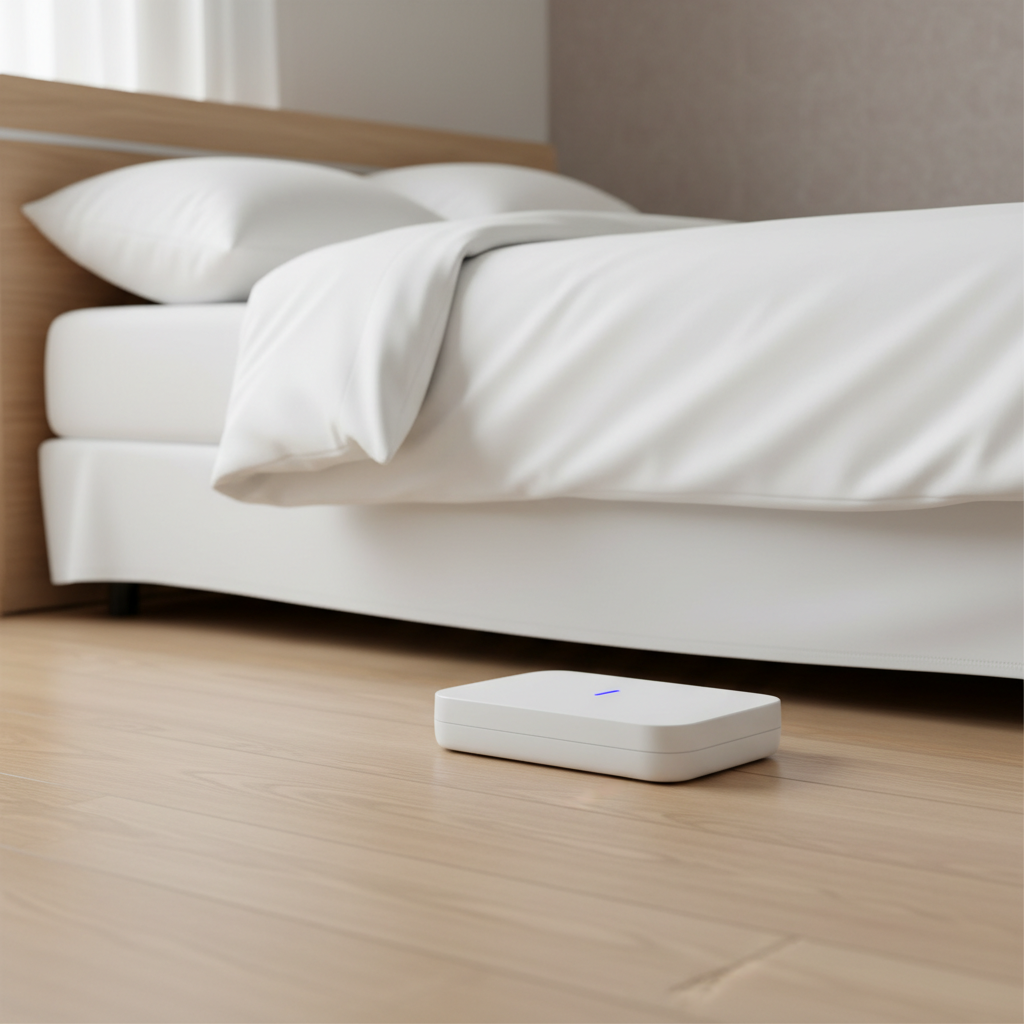

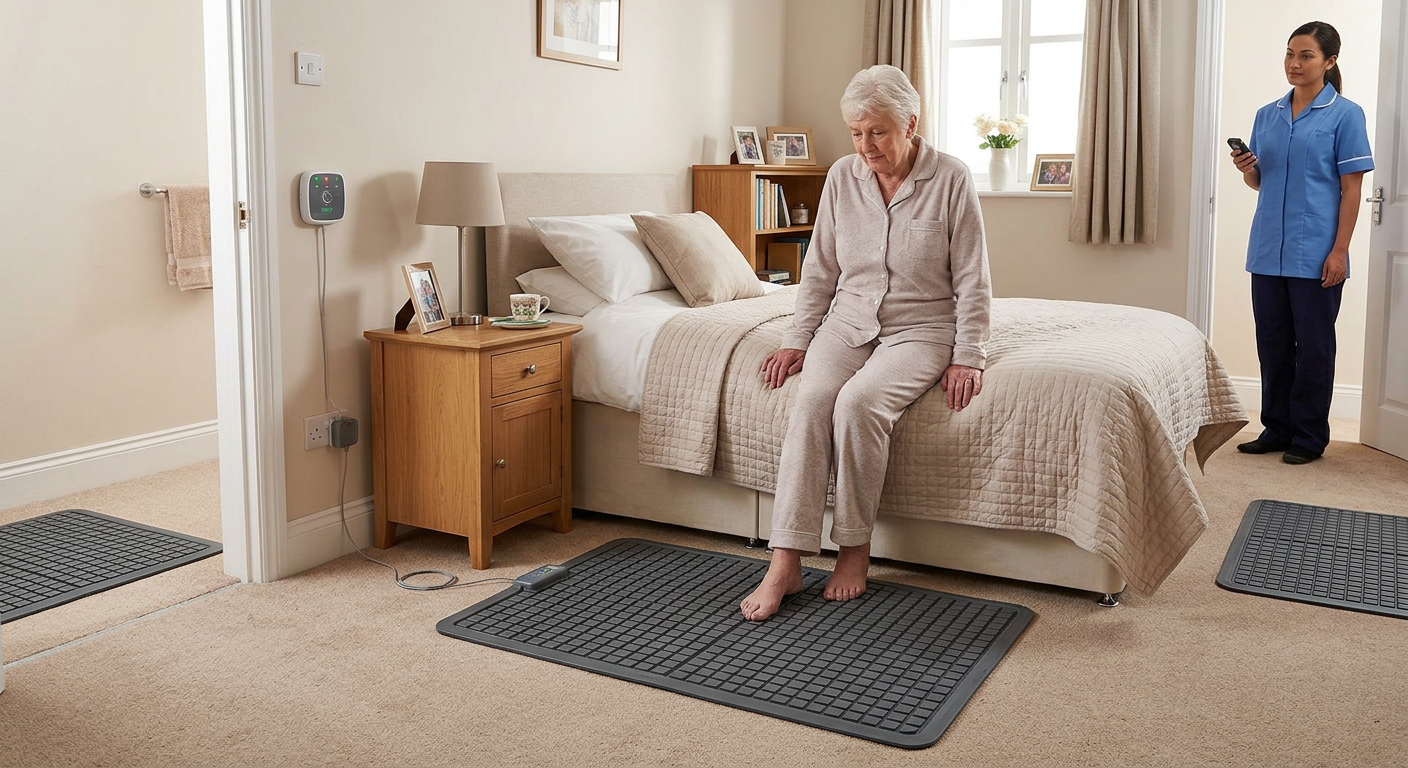
Tucked beside a bed, trailing a wire to a wall socket, slightly curled at the edges from months of use. The pressure mat: analogue, unglamorous, and still treated as a frontline defence against one of the most serious risks in residential care.
Falls cost the NHS an estimated 2.3 billion pounds a year. In care homes, they are the leading cause of injury-related hospital admissions among older people. And yet the primary technology deployed to prevent them in thousands of settings across the UK is a device whose fundamental design has not changed in decades. It is time to ask an uncomfortable question: are pressure mats actually preventing falls, or are they simply making providers feel like they are?
What Pressure Mats Actually Do
To be precise about the problem, it helps to be precise about what a floor pressure sensor mat does. It detects weight. When a resident steps onto it, typically placed beside a bed or chair, an alarm sounds at a nurse call panel or staff handset. That is the entirety of the intervention.
The assumption baked into this design is that a member of staff will hear the alert, respond quickly enough, and reach the resident before a fall occurs. In a well-staffed, well-designed environment, with a resident who moves slowly and predictably, this can work. But care homes are not always well-staffed. Residents do not always move slowly. And the gap between alarm and arrival is often measured not in seconds but in minutes.
A review of falls incidents across a group of 14 English care homes found that in over 60% of cases where a pressure mat alarm had activated, the fall had already occurred before staff reached the room. The mat had not prevented the fall. It had simply confirmed it.
The False Comfort of Compliance
Part of the problem is structural. Pressure mats appear in care plans. They are documented in risk assessments. They satisfy the box-ticking logic of compliance, a tangible, auditable intervention that can be pointed to during a CQC inspection. For providers operating under significant resource pressure, the mat offers something valuable: the appearance of a falls prevention strategy.
This is not cynicism. It is a rational response to a system that has historically rewarded documentation over outcomes. But the CQC Single Assessment Framework, with its sharper focus on evidence of impact rather than evidence of process, is beginning to shift that calculus. Inspectors are increasingly asking not whether a provider has a falls prevention tool, but how they know it is working.
For many providers, that is a question their pressure mats cannot answer.
What the Evidence Actually Supports
The falls prevention technologies that have demonstrated genuine outcome improvement share a common characteristic: they act earlier in the causal chain. Rather than detecting the moment a resident leaves their bed, they identify the conditions that make a fall likely and alert staff before the risk becomes acute.
AI-powered fall prediction analytics draw on data from electronic care records, vital signs monitoring, and movement patterns to flag residents whose fall risk is elevated. Ceiling-mounted radar sensors can detect changes in gait, posture, and movement speed that precede a fall by hours or days. Wearable fall detection devices can monitor balance and activity levels continuously, generating trend data that informs care planning rather than simply triggering reactive alerts.
None of these technologies are cheap. None are without implementation challenges. But the evidence base for predictive, data-driven fall monitoring is substantially stronger than the evidence base for reactive pressure mat alerting, and the sector’s continued default to the latter deserves scrutiny.
The Staffing Equation
There is a counterargument worth taking seriously. Pressure mats are inexpensive, require no connectivity, generate no data governance obligations, and work without training. For a small residential home operating on thin margins with high staff turnover, the practical case for a modest mat over a sophisticated sensor system is not trivial.
But this argument conflates affordability with effectiveness. A cheap intervention that does not prevent falls is not a cost-effective intervention. It is an expensive liability dressed in modest clothing. The costs of a serious fall, in human terms and in regulatory, legal, and reputational consequences, dwarf the cost of better technology.
The more honest conversation is about funding. Fall monitoring technology that actually works requires investment that many providers cannot currently access without support from integrated care systems, local authorities, or national programmes. The sector needs that conversation to happen at a policy level, not to be quietly avoided by pointing at a mat on the floor.
A Tool, Not a Strategy
None of this is to say pressure mats have no place in a falls prevention approach. Used as one element within a broader, data-informed strategy alongside predictive analytics, environmental assessment, personalised care planning, and adequate staffing, they can play a supporting role. The problem is not the mat. It is the tendency to treat the mat as the strategy.
Falls prevention in UK care homes will not improve meaningfully until providers, commissioners, and regulators stop accepting reactive alerting as a substitute for genuine risk reduction. The technology to do better exists. The evidence to justify it exists. What is needed now is the honesty to admit that what has been good enough for decades is no longer good enough at all.