
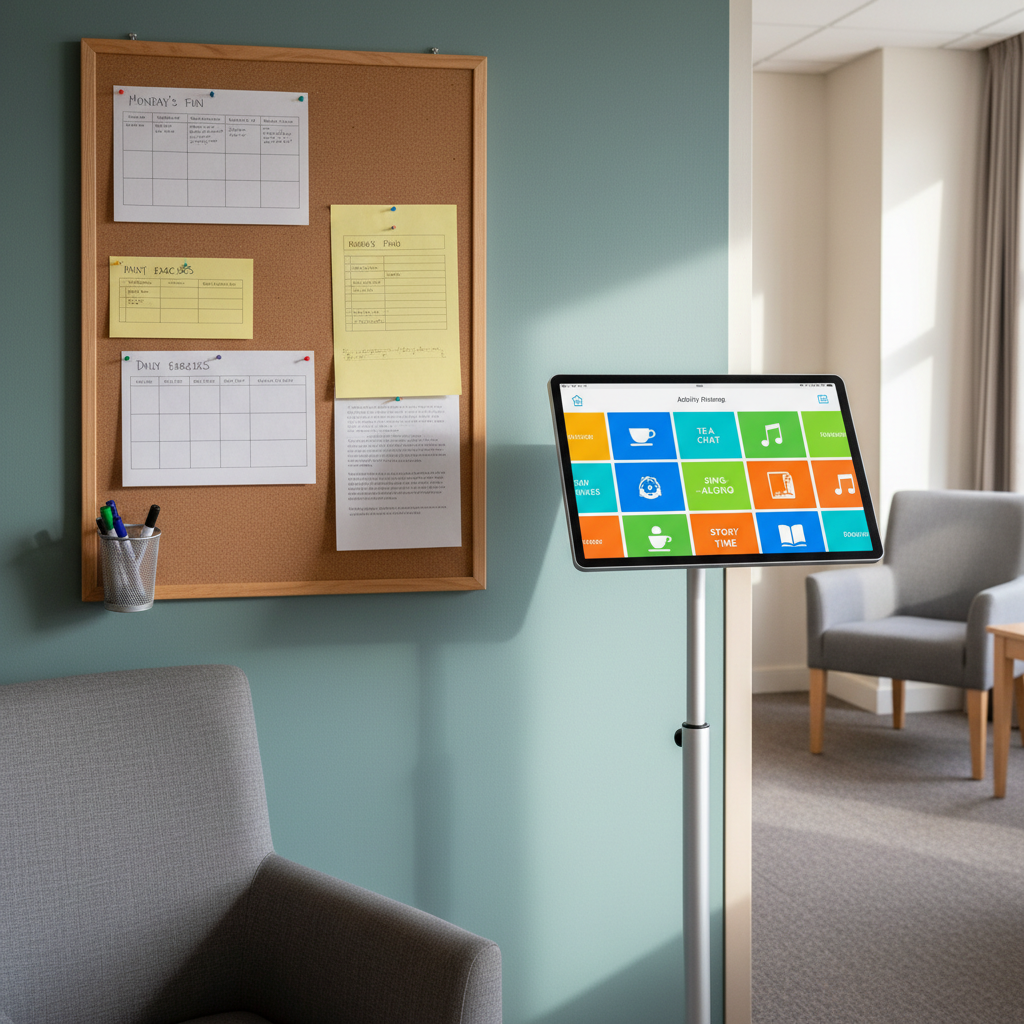
Walk into almost any care home in England today and you will find, somewhere near the entrance or the communal lounge, a noticeboard. On it: a printed weekly activities schedule, perhaps a few photographs from last Tuesday’s bingo session, and a laminated sheet listing the names of the activities coordinator and their hours. Beside it, increasingly, you will also find a tablet on a stand running one of a growing number of digital activity planning and engagement platforms. The question nobody is asking loudly enough is: is the second thing actually replacing the first, or just digitising it?
The market for digital activity planning tools in UK adult social care has expanded considerably over the past five years. Platforms such as Oomph Wellness, Nourish‘s activities module, and a clutch of newer entrants promise to transform how care homes plan, deliver, and evidence resident engagement. The pitch is compelling: personalised activity programmes, automated reporting for CQC evidence, family visibility into what their loved ones are doing, and data-driven insights into resident wellbeing. On paper, it is exactly what the sector needs.
The Evidence Gap
The problem is that the evidence base for meaningful outcomes is thin. Providers can demonstrate that they are using a platform. They can show that activities have been logged, that attendance has been recorded, that families have received notifications. What is far harder to demonstrate is whether any of this is making residents’ lives measurably better.
This is not a trivial distinction. The Care Quality Commission‘s new single assessment framework places significant weight on wellbeing outcomes, not just activity throughput. Inspectors are increasingly asking not whether a quiz ran on Wednesday, but how a provider knows a resident is thriving. A digital activity log that records attendance without capturing mood, preference, or meaningful participation is, in effect, a more expensive version of the paper register it replaced.
There is also a deeper tension at the heart of these platforms. The most sophisticated tools offer personalisation engines that suggest activities based on a resident’s life history, cognitive profile, and past engagement patterns. In theory, this is powerful. In practice, it depends entirely on the quality of data entered at the point of admission and updated over time. In a sector where staff turnover runs at over 30% annually and activities coordinators are often part-time, the data hygiene required to make personalisation work is rarely achievable at scale.
What the Sector Is Actually Buying
Speak to activities coordinators and a more nuanced picture emerges. Many value the reporting functionality, particularly the ability to generate CQC evidence quickly. Several describe the family communication features as genuinely useful, especially in the post-pandemic period when relatives remain anxious about visibility into daily life. But the personalisation features? Largely unused. The analytics dashboards? Rarely opened. The integration with care planning systems? Frequently non-existent in practice, even when promised in the sales process.
What providers are largely buying, then, is a compliance and communication tool dressed up as an engagement platform. That is not worthless. But it is a significantly narrower value proposition than the one being marketed, and it raises questions about whether the investment is being directed at the right problem.
The Real Barrier?
The uncomfortable truth is that the limiting factor in resident engagement is not the absence of a digital platform. It is staffing. A care home with an engaged, well-supported activities team and a paper diary will consistently outperform one with a sophisticated digital platform and a single part-time coordinator stretched across 60 residents. Technology cannot substitute for human presence, creativity, and relationship, and the platforms that imply otherwise are doing the sector a disservice.
This does not mean digital activity planning tools have no role. The best of them genuinely reduce administrative burden, improve family communication, and create an evidence trail that supports regulatory compliance. Some are beginning to integrate meaningfully with electronic care records, creating a more holistic picture of resident wellbeing that spans clinical and social dimensions. That integration, when it works, is where the real value lies.
A More Honest Conversation
What the sector needs is a more honest conversation about what these platforms can and cannot do. Commissioners and providers should be asking vendors harder questions: not just whether a platform can log activities, but whether vendors can show outcome data from comparable providers, demonstrate that residents in homes using their platform report higher wellbeing scores, and explain what integration with care planning systems actually looks like in a live environment.
And providers themselves need to resist the temptation to treat platform adoption as a proxy for quality. A digital activities schedule is not evidence of a good life. It is, at best, a tool that might support one, if the staffing, the culture, and the genuine commitment to resident-led engagement are already in place.
The noticeboard and the tablet can coexist. But only one of them will ever truly know what a resident loves.
Related Reading
- The Care Home That Knows Before You Do: Why Ambient Assisted Living Is No Longer Optional
- Your Resident Has a Digital Twin. Now What?
- Digital Care Management Platforms in UK Care Homes: Where Are We in 2026?
Frequently Asked Questions
What are digital engagement platforms for care homes?
Digital engagement platforms provide tablets, touchscreens or apps to help residents access activities, video calls, music, games and reminiscence content. Examples include platforms designed to reduce isolation and support cognitive stimulation in residential and nursing care settings.
Do digital engagement platforms improve resident wellbeing?
Evidence is mixed. When well-implemented with staff training and resident involvement in content choice, platforms show measurable reductions in loneliness and boredom. Poorly implemented rollouts—where devices sit unused—show no benefit and can increase frustration.
What should care homes look for in a digital activities platform?
Look for ease of use for residents with limited digital literacy, personalisation options, staff dashboard tools, content that reflects diverse backgrounds and interests, and clear outcome measurement. Avoid platforms that promise engagement without supporting implementation.